


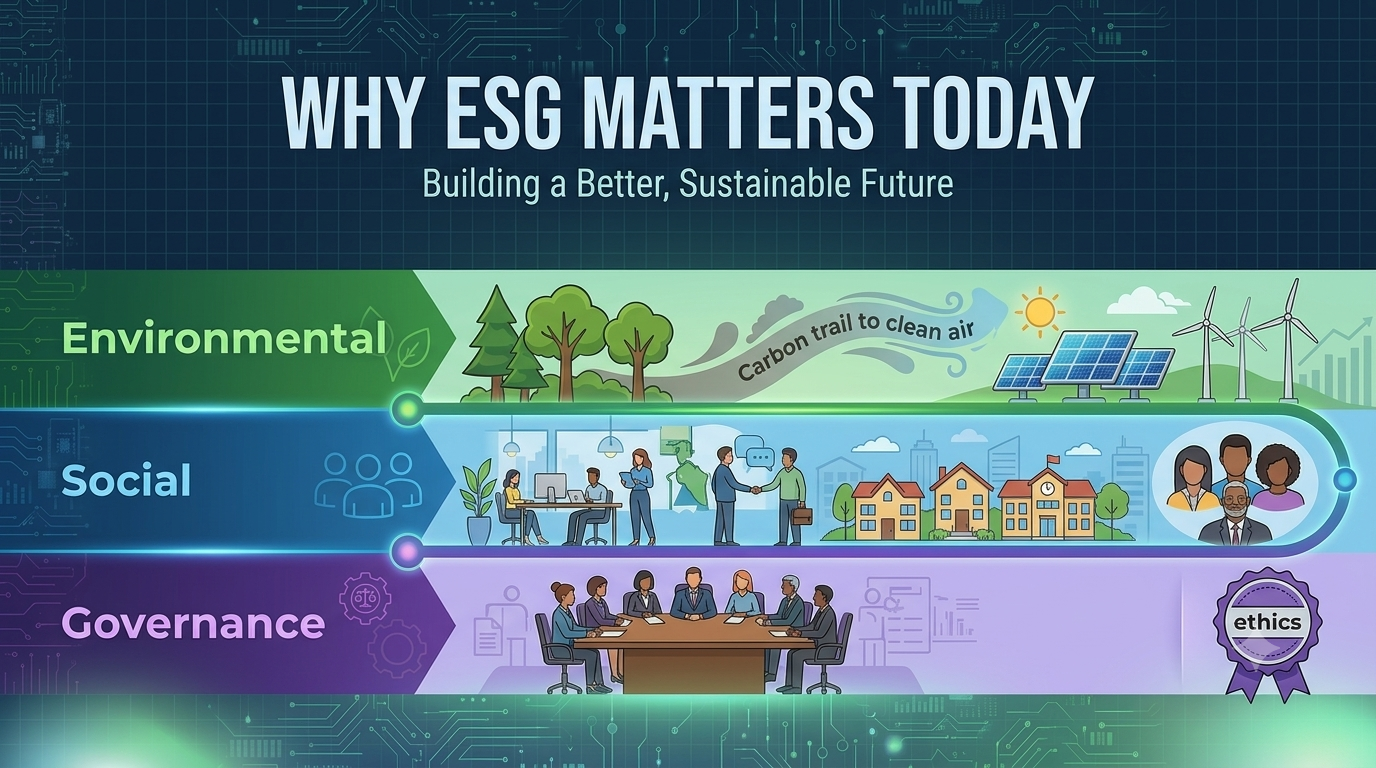
ESG (Environmental, Social & Governance) practices are essential to combat global warming caused by our collective carbon footprint. Understanding how our atmosphere works — and what's changing it — is the first step.
Earth's Atmosphere Structure
The atmosphere is made up of five layers, each with distinct temperature characteristics:
- Troposphere (0–15 km): Temperature ranges from 15°C to -50°C, dropping about 6.5°C per kilometre of altitude.
- Stratosphere (15–50 km): Temperature varies from -50°C to 0°C.
- Mesosphere (50–85 km): Temperature ranges from 0°C to -90°C.
- Thermosphere (85–600 km): Temperature increases from 90°C to +1,500°C with height.
- Exosphere (700–10,000 km): Temperature reaches approximately 2,500°C.
The Ozone Layer
The protective ozone (O₃) layer is around 3mm thick and sits at a height of 20–30 km. The stratosphere stays between -60°C and 0°C because ozone absorbs ultraviolet radiation. At ground level, however, ozone becomes a pollutant when it forms from reactions between VOCs and NO₂.
The Seven Greenhouse Gases (GHG)
- Carbon dioxide (CO₂)
- Methane (CH₄)
- Nitrous oxide (N₂O)
- Hydrofluorocarbons (HFCs)
- Perfluorocarbons (PFCs)
- Sulfur hexafluoride (SF₆)
- Water vapour
Global Warming
In the early 1960s, scientists recognised that carbon dioxide in the atmosphere was increasing. They subsequently found rising levels of methane, nitrous oxide and other gases too. These greenhouse gases trap heat the same way a greenhouse retains solar warmth — leading researchers to conclude that rising GHG concentrations would accelerate global warming.
Global Warming Potential (GWP)
GWP measures how much heat a greenhouse gas traps relative to carbon dioxide over a set period (usually 100 years):
- Carbon dioxide: reference value of 1
- Methane: 28 times more potent
- Nitrous oxide: 298 times more potent
Carbon Footprint
A carbon footprint is the total amount of greenhouse gases, particularly carbon dioxide (CO₂), that are emitted into the atmosphere due to human activities — typically measured in tonnes of CO₂ equivalent per year.
Why This Matters
Tackling global warming caused by our collective carbon footprint means paying close attention to environmental factors — and implementing ESG practices is an essential part of that strategy.